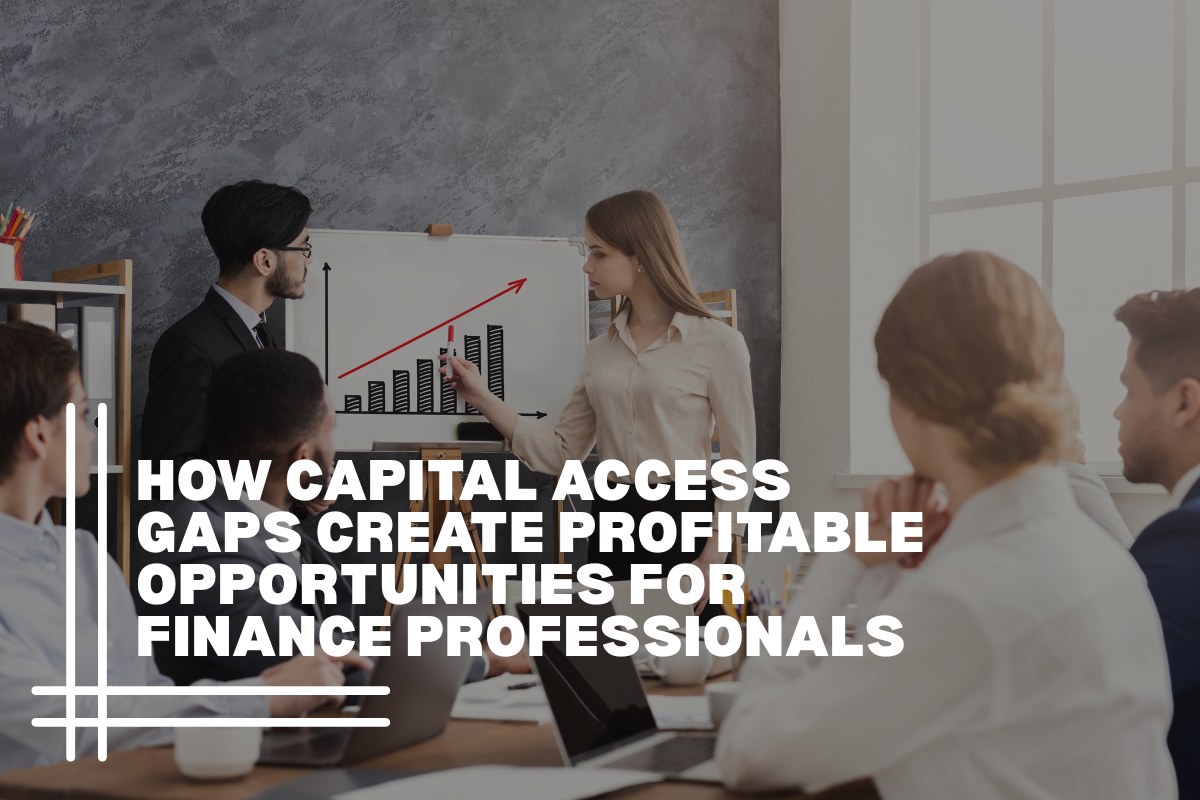
Capital access gaps—situations where viable businesses cannot obtain funding through traditional channels—have become a defining feature of the modern financial landscape. While these gaps present challenges for businesses, they also create significant and often overlooked opportunities for finance professionals. As traditional lending models struggle to keep pace with changing business realities, professionals who can bridge these gaps are finding scalable, resilient, and highly profitable career paths.
What Capital Access Gaps Really Are
Capital access gaps occur when businesses have legitimate funding needs but are unable to secure capital through conventional means. This does not necessarily indicate poor performance or high risk.

Common causes include:
- Rigid bank underwriting standards
- Nontraditional or modern business models
- Inconsistent or seasonal cash flow
- Limited operating history
- Time-sensitive capital needs
These gaps are structural, not temporary, and they continue to widen as business models evolve faster than traditional finance systems.
Why Traditional Lenders Leave So Many Businesses Underserved
Banks are designed for consistency, regulation, and risk minimization. As a result, they rely heavily on standardized metrics, long approval cycles, and narrow credit profiles.

While this approach protects balance sheets, it leaves many creditworthy businesses without options. The gap between what banks can fund and what businesses actually need creates space for alternative solutions—and for professionals who understand how to deliver them.
Capital Gaps Exist in Strong and Weak Economies
Capital access gaps are not limited to downturns. In strong economies, businesses need fast capital to grow, expand, and compete. In uncertain economies, they need capital to stabilize, restructure, or survive disruption.
Because these gaps exist across economic cycles, they represent a consistent and renewable source of opportunity for finance professionals rather than a cyclical one.
Where Opportunity Emerges for Finance Professionals
Finance professionals who understand capital markets, deal structuring, and alternative funding solutions are uniquely positioned to profit from these gaps.
Opportunities arise in:
- Deal origination and brokerage
- Capital advisory and structuring
- Alternative and private lending
- Commercial finance consulting
By connecting businesses with appropriate capital sources, professionals create value for both sides of the transaction.
Value Is Created Through Problem-Solving, Not Just Capital
The most profitable opportunities do not come from simply providing money—they come from solving funding problems. Each capital gap requires analysis, creativity, and structure.
Finance professionals add value by:
- Assessing real cash-flow performance
- Matching businesses with suitable capital products
- Structuring deals that align repayment with operations
- Navigating complexity traditional lenders avoid
This expertise commands premium compensation.
Capital Gaps Enable Higher Margins
Because underserved businesses have limited options, solutions that responsibly bridge capital gaps often support higher margins than commoditized bank lending.
Professionals are compensated for:
- Speed
- Flexibility
- Customization
- Access to nontraditional capital
As long as value is delivered ethically and sustainably, these margins reflect problem-solving rather than exploitation.
Relationship Compounding Multiplies Opportunity
Businesses that successfully bridge a capital gap often become repeat clients. As companies grow, their capital needs evolve, creating ongoing deal flow.
This relationship-driven model leads to:
- Recurring transactions
- Referrals within industries
- Reduced client acquisition costs
- Long-term income compounding
Over time, a single relationship can generate multiple profitable engagements.
Technology Is Expanding the Reach of Capital Gap Solutions
Technology has made it easier for finance professionals to identify, assess, and serve underserved businesses. Data-driven underwriting, digital platforms, and remote deal execution expand reach across industries and geographies.
This scalability allows professionals to operate beyond local markets and build national or multi-industry practices centered on capital gap solutions.
Ethical Opportunity Aligns With Long-Term Growth
When approached responsibly, addressing capital access gaps benefits both businesses and finance professionals. Businesses gain stability and growth capacity, while professionals build reputations, networks, and durable income streams.
The most successful professionals focus on:
- Long-term client success
- Sustainable deal structures
- Transparency and alignment
Ethical execution strengthens trust and increases lifetime value.
Capital Access Gaps Are a Structural Opportunity
Capital access gaps are not closing—they are expanding as business innovation outpaces legacy finance systems. This makes them a structural opportunity rather than a temporary imbalance.
Finance professionals who understand how to navigate, structure, and serve this space are positioned to build scalable careers, firms, and long-term wealth.
Turning Market Inefficiency Into Professional Advantage
Every capital gap represents a market inefficiency. Finance professionals who can operate where traditional systems fall short transform inefficiency into value.
By bridging the space between business need and available capital, professionals do more than close deals—they become essential infrastructure in the modern economy.
Frequently Asked Questions (FAQ)
Q1. What is a capital access gap?
It is a situation where a viable business cannot obtain funding through traditional lenders despite having legitimate capital needs.
Q2. Why do capital access gaps create opportunity?
Because underserved businesses still need capital, creating demand for alternative solutions and expert intermediaries.
Q3. Are these opportunities only during economic downturns?
No. Capital access gaps exist in both strong and weak economic conditions.
Q4. Do finance professionals need large capital to participate?
Not necessarily. Many opportunities involve structuring, advising, and connecting capital rather than deploying personal funds.
Q5. Is addressing capital gaps sustainable long term?
Yes. As business models evolve faster than traditional finance systems, these gaps are expected to persist and expand.